
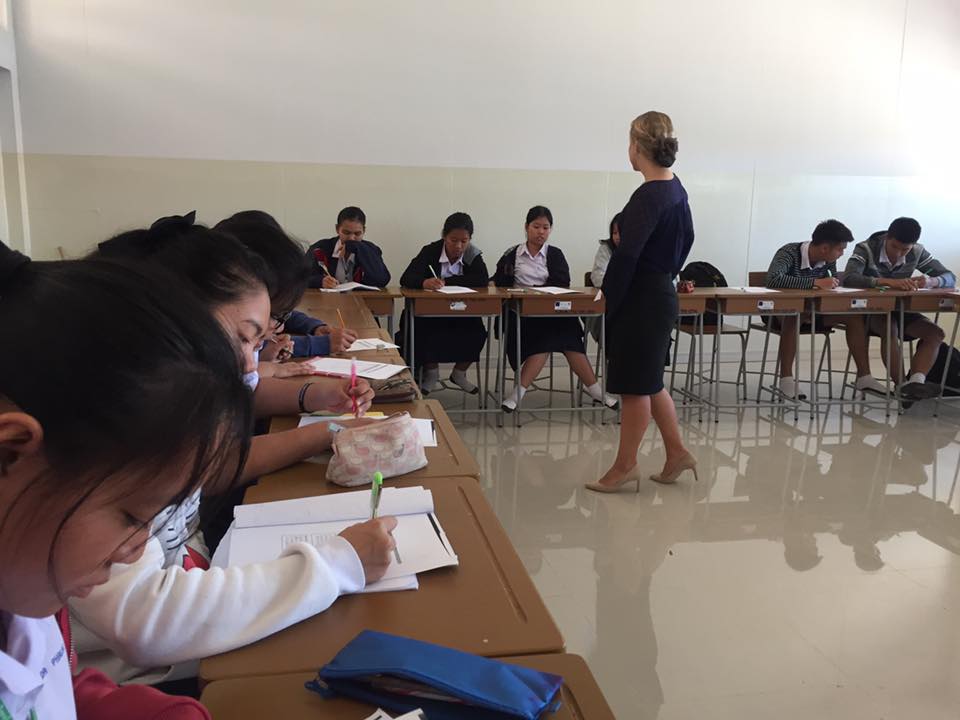
Now that I’ve been here for just over four months, I feel that my footing in Thailand has shifted. I no longer feel like someone who is perpetually learning – learning new words, learning new customs, learning new directions, learning new faces and names. Instead, I feel like the person I came here to be: a teacher.
I feel comfortable in my office and at ease as one of the staff members. I’ve adopted Thai-teacher-style as much as possible, meaning I wear Thai-style hair clips (thanks to Teacher Boom), Thai-style skirts (thanks to Mom Teung), broaches to honor the King, more lipstick and eye shadow than I even knew could fit on my face, and high heels. Thai teachers are beautiful and elegant and take a lot of pride in their appearance. I’ve learned (though I should have realized before) that a major part of owning the job is dressing for it.
I also hit a point recently where all of the random words I’ve learned are tangentially connected enough that I can understand entire dialogues (though I remain completely illiterate). Speaking the tones is still a challenge for me, but a flip has switched in my mind so that discerning them has become easy where previously it was impossible. The conversations in my office about classes and field trips and the weather and lunch have been absorbed by my brain enough times that they’ve suddenly become clear, and my students squeal with delight when I break out of my English to ask them, kow jai mai (Do you understand?) or weigh in on their Thai conversation.
In Thai language, nothing is gendered like in the romance languages I’ve studied before. Instead, the speaker is what’s gendered. At the end of each phrase, if intending to be polite, women add the word ka and men add the word krap. The most similar situation in English might be adding “Sir” or “Ma’am” to the end of one’s sentence, but even that is based on who is being spoken to, not the speaker his or herself. One of my favorite gaffes that my students make is continuing to put the polite Thai ending on their English phrases. “Good morning ka!” and “Thank you ka!” Similarly, since Thai is a tonal language and inflections do not indicate a query as they do in English, question phrases end with the word mai. Sometimes, to make sure my students are understanding and happy, I ask them, Ok mai? They’ll reply, Ok ka, Teacher!
Classes have become somewhat regular (I recently had an entire week where none of my classes were cancelled – a first, for me), and so has my face time with my students. In Thailand, the middle and high school grades are called Mattayom 1- 6, M1 correlating with our 7th grade, and M6 with our high school seniors. Each grade level is further subdivided according to standardized examinations (the dreaded ONETs) given prior to entering M1 and again before M4. Based on the student’s performance, he or she is placed in M1-1, M1-2, M1-3, etc. for as far as the school necessitates. All of my students are in the highest level – “slash 1” – meaning I teach M1-1, M2-1, M3-1, M4-1, and M5-1.
Ban Phaeng has a special curriculum that we call IEP – Intensive English Program – and students pay 5,000 baht (roughly $155) a semester to be a part and to study English with a native speaker. This is quite a fee, but I’ve recently discovered that it’s not an opportunity only the rich in Ban Phaeng undertake. When I learned of the striking poverty in which one of my students, Book, lives, I was greatly saddened by his situation. “Don’t worry,” one of the teachers explained, in an attempt to comfort me, “many, many students in our school are very poor!” This, of course, was no comfort at all, but it did open my mind to the fact that many parents are willing to give what little they make to further their children’s opportunities, and that I, in turn, have an even larger responsibility to contribute what I can to their education.
In IEP, half of all science and math courses are to be taught in English by a native speaker as well. When I first arrived, before I knew the nuances of this program, the teachers tried to convince me that I had to teach math and science alongside English, subjects I have not studied since I, myself, was in high school. WorldTeach stipulates that I am only to teach English, so I inherited strictly these classes while Jon, a Hawaii-born American who lives with his Thai wife and two children, was given the math and science curriculum. This means that I see all of my classes four hours a week, and subsequently have been able to tackle many lesson plans with them and grow increasingly close to the individual students.
That being said, the M1 class is my least favorite by far (Think: attention-seeking thirteen-year-old boys who glue their hands to their desks and climb out the window for kicks, and painfully self-conscious thirteen-year-old girls who don’t make a peep). I had been struggling with how to bridge their maturity gap for a few weeks, and was frustrated with being unable to channel their sassy energy toward learning English. This past week, I planned games and brought in snacks to try out rewarding their good behavior. The class actually went fairly smoothly, until we were changing activities and I had my back turned as the students were returning to their seats. One of the sweeter girls was suddenly sobbing uncontrollably, and her friends were swarming her with an embrace. After endless cajoling and getting her (and her friends) out of the room where we could talk in private, it was revealed that one of the boys had yanked down her pants in front of the whole class. She was mortified.
After sending her and her friends to their advisor, I returned to the classroom to the devastated faces of the remaining students. The boys were shouting at each other and seemed to be pretty frightened about what I would do, and the girls were upset on behalf of their friend. When I tried to address the offender, he himself burst into tears, “Teacher, so sorry!”
The whole incident made me see these students for what they really are: little kids. It’s easy to get annoyed with their cliques and their loudmouths and their painful silences as a whole, but looking at them individually, they seemed more like infants. I told them we would continue the rest of the lesson next time, and instead listen to music and eat snacks. They were so grateful that at the end of class, they apologized to me for getting out of control. “We love you!” They said as they walked out of the room.
Aside from these rambunctious 7th graders, my students are all astoundingly respectful and well behaved. They wait in the doorway of my classroom and ask, “May I come in please?” before entering. They approach me if I’m carrying anything heavy and take it off my hands. They erase the board for me, and they run around adjusting the fans in the classroom when I make asides about being hot or cold.
Even though Thailand exudes a relaxed approach to life, the students themselves are rather disciplined. Each morning, a few teachers stand at the front gate of the school and greet the students as they arrive. They are to say “hello” in Thai to the Thai teacher present, “good morning” to me, and a greeting in Chinese to Fang. If something about their uniform is out of place as they walk in – mismatched socks, makeup on the girls, a missing belt – they receive a smack to their bottom with a stick. Each class has an area of the school that they are supposed to clean in the mornings, and if they fail to do so, they receive more spanks. During morning assembly, students sing the Thai National Anthem as the flag is raised, they sing the King’s Song, they vocalize a Buddhist prayer and then pray in silence for two minutes, and they recite the school rules. After all of this, they sit on the pavement in class-ordered rows, where they are to listen to daily announcements in silence. If the boys goof around – which they always do – a teacher comes through with a pair of scissors to snip bald spots into their scalp, a technique that marks them with shame for the rest of the day.
My M3 class has 45 students, but the energy in the room is something I’ve never experienced. They are attentive, serious, and constantly motivated to absorb whatever lesson plan I have for them. My M4 class has only 6 students, so rather than lecture them on tenses and participles, we have open discussions on any topic they want, from my life, to their dream vacation, to how they feel about high school. My M5 class consists of all my shining stars – 19 students who are incredible, hilarious, sweet individuals. They learn quickly, they refer to me as Khru (the most polite way to say “teacher;” Adjune being the more commonly-used word), and they make me laugh endlessly. They have started to imitate me saying, “Ok, guys, listen,” and they love to see my reactions to different Google-translated phrases: “Teacher, I afraid varying combinations many of snakes,” and “Teacher, is the correct translation candy, or sweetmeat?”
I would love to see this class graduate, which is why I’m considering extending my time here for just one more semester. After observing my class one day, Teacher Boom asked the students if they wanted me to stay. Yak! (want!) they shouted as they jokingly got on the floor and groveled at my feet. Such sweet kids, right? How could I refuse?


 me, myself, and thai